

So Personal, So General
“Any woman or man who would write the truth of their lives would write a great work. But no one has dared to write the truth of their lives.” – Isadora Duncan
The Sound Diary project is an ongoing, serial artistic collection that heightens the sonic medium and semiotic uniqueness of a sound art practice, such that it conveys free creative expression as a factual existence in the world by attaching “narrative” to “sound”. Through the five official works of this project, a broad range of media platforms are incorporated, and it continues and expands into further experiments on the embodiment of sound narratives across media. Coming from a social background of high cultural conformity (South Korea), aRing has been walking a fine line on the verge of the mainstream without conceding to the commercialization of her productions as a sound artist. In such a culture, her innovative but unpopular styles or forms of artworks are often ephemeral, existing only in their moment of performance/exhibition, becoming invisible due to the inherent time-based disposition of these musical arts. However, the residue – texts, music scores, storytelling conceptualizations, and audio and video resources, can subsequently become visible content when transformed into digital presentations, or when they are inherited by the next performance on the boundless platform of contemporary art. Through continuous artistic activity, the Sound Diary project transcends the limitations of time and space, and can be shared and re-lived for a broader audience.
PROJECT ARTWORKS
Sound Diary No. 6 - From Tillandsia to Nabillera (2017~on going)
From Tillandsia to Nabillera is the sixth and most expansive work in the Sound Diary series. Initiated in Hong Kong and now rooted in Korea, it spans multiple years and five unfolding stages of artistic metamorphosis. Inspired by two metaphorical organisms—Tillandsia, a rootless air plant, and Nabillera, a poetic butterfly-like term from Cho Ji-hoon’s Seungmu—this work explores how art survives and transforms amid adversity.
Structured as a sequence of Physi-Musiking installations and live experiences, the work combines soundscapes, bodily movements, poetry, images, and spatial design, often in site-specific, improvisational formats. Key aesthetic values include:
-
Naturalness: raw, minimally edited sound and field recordings
-
Craftsmanship: visual textures reminiscent of Korean ink painting
-
Mortality: existential vulnerability and lived crisis as material
Developmental Phases:
-
Prelude Stage: Tillandsia in the Lost Garden (2017, Hong Kong): Visual-music prelude; egg/larva stage.
-
Development Stage 1 (Metamorphosis I): eARTh & I (2019~2020): Sonic protest and land art in response to forced orchard redevelopment.
-
Development Stage 2 (Metamorphosis II): Artist & Orchard (2021–25): Farming, sound education, and community integration.
-
Development Stage 3 (Metamorphosis III): Chrysalysis (2026~?): Sonic Bench, Artist Residency collaborations, etc.
-
(Future Butterfly Stage): Culminating work to emerge from this multilayered cocoon.
The Artist’s Orchard, selected as part of the 2025 Chungnam Arts Hub initiative, serves as the living site of these transformations. There, aRing fosters rural arts education, artist residencies, and community workshops—converging philosophy, activism, and sound into an integrated cultural praxis.
This project is not just an artwork; it is a lived resistance, a spiritual journey, and a relational archive in progress.
Sound Diary No. 6 - Prelude Stage: <Tillandsia In the Lost Garden>
Exhibition Title: <Tillandsia in the Lost Garden> by aRing
Prelude Stage of Sound Diary No.6 <Tillandsia to Nabillera>
Venue: nakedHub Gallery
Address: G/F, 5–13 New Street, Seung Wan, Hong Kong
香港上環新街 5-13號地下
Dates: November 17–30 (9 am to 6 pm)
Opening Night: November 17th @ 6:30pm (Performance starts at 7pm)
Improvisational Dance with Live Sound and Yoga Workshop: November 18th
Presented by: Sonic Arts and Culture
About the collection:
Introducing a new work by the creative, genre-disrupting Korean sound artist aRing (a.k.a. Irene Eunyoung Lee) (b.1974), <Prelude Stage – Tillandsia in the Lost Garden> presents an introductory installation & performance artwork, part of a progressively developing, multi-year project named <From Tillandsia to Nabillera> by the artist. On the opening night, aRing will present a live-performance and collection of photographs mapping the endeavor through a series of bodily practices and sound organizations, to craft an inventive form of visual music called “Physi-Musiking”. In <Prelude Stage>, aRing has created a visual presentation of her texts and sounds using still camera shots of physical movements with wearing vivid silk fabrics. Although originally intended to design a multi-channel audio installation, this has been modified into a mixed, two-channel format due to the circumstances of the co-working venue, and will be experienced using a headphone. The ‘Sound Diary No.6 <From Tillandsia to Nabillera>’ series aims to create installations of physically-driven abstract images to emphasize the purity of sound/music experienced in 360 degrees, in a total of five different stages, over a period of two years. ‘Sound Diary No.6 <From Tillandsia and Nabillera>’ is a series of proposals for installations of physi-musiking situations (i.e. abstract auditory-visual experiences generated from the movements of physical bodies and textiles, emphasizing the purity of organized sound). These are to be experienced in new productions presenting various willed yet spontaneous encounters, on a pilgrimage of self-study achieved through the combination of sound, movement, and vision. Such encounters are comprised of interactions with new people, environments, and technologies developing into several flowing stages (ideally within a mobile dome or sphere). All these situations consist of three basic elements: sound layers—the sonic “seeds”—are consciously organized according to textual keywords, musical expressions, and field recording samples; visual layers—the spatial “environments”—are moving images of color palettes expressing the emotions of texts and/or the juxtaposition of video/photo images with the contemporary world experienced during the pilgrimage journey; and physical layers—the human “sprouts”—are reactions or elements that occur when other creative or audience influences are encountered. As a result, the narrative sound layers will be revealed as reference sources to each (modal) human-catalyst. The instructions on how to create junctures between these situations consist of both directed and open approaches to creative production that require mutual-conciliated agreements between the creative participants.


Sound Diary No. 5 - Now's Tomorrow
aRing’s most latest total sound art theater work was Now’s Tomorrow, which premiered at the Mtheater in Seoul on December 7th , 2012. Mostly non-verbal organized sound as an abstract main energy, it led the audience to follow a fiction-based storyline with physical theater. The audience was located on the second floor, so they had to look down on the performance from the upper level. Its intention was to sympathetically deliver a story of a woman whose marriage ended in a deception, which then embroiled her in chaotic errors and confusions that made her feel as if she were teetering on the edge of a cliff. Every scene had its short storytelling texts written from real-life situations, which shared an associated audio track produced by the artist. The audio track carried its corresponding text contexts, and the physical theater actors interpreted the texts with their body expressions in accordance with the soundtracks. Now’s Tomorrow was composed of 10 scenes including a short introduction, and each of the nine scenes illustrated the progressive phases of self-development. Six physical theater actors (3 male and 3 female) and a sound artist performed live on stage, and 12 staff (stage directors and assistants, video operatives, costume staff, management, etc.) participated in the theatrical work.
The stage/physical theater director, Myungil Lee, who had past experience in collaborating with aRing for the Mung work, had a deep understanding of aRing’s work. However, actual actors and actresses did not understand what the performance was about and why this kind of self-centered narrative performance could be a vital art expression. While the physical theater played a rather minor role in the narratives in Mung as a whole, it was used for the main leading narrative leader in Now’s Tomorrow . Therefore, sufficient communications between physical theater actors and aRing was compulsory in realizing a successful theatrical performance. After the actors understood what aRing had put into art practice and what artistic vision she was pursuing, through face-to-face talks, the creative processes moved along swiftly. Characterizing the role of each actor and actress in the theater was not necessary. In aRing’s sound art theater, the whole performer group was like an organism with different parts carrying out their own tasks. Every performer was like a part that performs its necessary functions independently and interdependently. Although one layer of the show depicts a story of a woman in a predicament, it is, in fact, a story of the self-development of a human being. The lifelong progress involves phases such as affection, frictions, daring, confrontation, consciousness, acceptance, compensation, balance, and perseverance.


Sound Diary No. 4 - MUNG
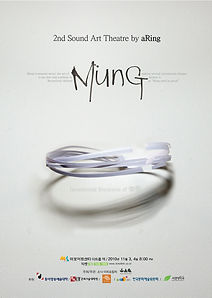
The Mung, was a reiterated theatrical performance of RockMong (Sound Diary No. 3). The computer terminology title “mung” denotes its function as an incremental recursion work – a recursive work of RockMong – that will destroy the original. The 70-minute theater added more diverse elements such as newly organized sounds, custom-tailored costumes, and physical theater acting in addition to the artistic expressions used in the earlier work. The most important change from the previous performance was that the main theme represents more the symbolization of communication between God (or Supernatural Omnipotent Power) and the human being than the relationship between an artist and his/her persona. The newly-added last scene (no. 15), called “Dreaming for a Living Paradise”, represents anticipation to become a congruent, existent, art-living being in current life after the destruction of the original by completing realization of the Mung. Seven scenes out of a total of fifteen had lyrics for live singing, while other scenes mostly had texts for live narration with real-time audio signal processing accompanied by recorded tape music. 7 live musicians (two sopranos, 1 traditional Korean singer, 1 piano, 1 flute, 1 cello, and 1 electronic musician), 5 physical theatre actors (three male and two female), and 31 staff (stage directors and assistants, and art, costume, and audio engineers) participated in the final theatrical work. The theatrical performance was presented at Mapo Art Center in Seoul, Korea on November 3rd and 4th , 2010. Later on, a related exhibition and performance was held at the Incheon Art Platform C Building in South Korea from July 1st until July 6th, 2011.


Sound Diary No. 3 - Rock Mong (樂夢)
For RockMong, the third work, the artist first completed her 36,471-word novelette (written in Korean) titled Jin’s Blue Closet. The factual fiction book revealed the story of the enormous suffering of a new artist from the incongruity tendencies in endeavoring to live a “life-dedicated-to-sound”. Its final theatrical performance employed multi-modal media with live performances. The artist utilized various video and sound components from her previous experiments into the final sound art theater. aRing designed the final output stage to produce a whole concoction of narrativity, fictionality, non-fictionality, literariness, recorded moving images, and organized sounds. The artist entitled the whole process of the creating the RockMong, an “a posteriori remediation”, which indicatively emphasizes its mixed loadings of various tiers of narratives spawned from making a dramatized theatrical performance based on a mockumentary-style novel written by aRing. The final theatrical performance was premiered at the Boryung Art Center on November 5th of 2009. The 40-minute production consisted of interactive digital music with live classical performances, dramatic acting, lights, contemporary dance, and moving images. This performance aided the Korean artist to create a “total sound art theatre” work. She wrote a novelette, composed and organized all the music and sounds, created moving images, programmed a laptop-based interactive music system utilizing electroencephalogram, and appeared on the stage to control electro-acoustic music and perform dramatic actions. The artist was fully in charge not only of matters relating to artistic creation, but also to earning grants, managing budgets, the management of artists and staff, and the business and promotion relations for the entire production.


Sound Diary No. 2 - Sweet Blessing and Beyond...
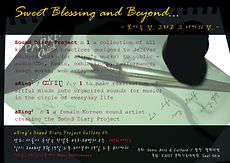
The second audio CD work is called Sweet Blessing, and its associated exhibition was presented in 2006 at <PyungHwa DaBang> in Seoul, Korea. A 45-minute video work named The Sweet Blessing and Beyond, a 100-page collection of handwritten work notes, interactive sound diary web contents, and live music performances were presented together with the Sweet Blessing, a new audio CD release, as the core of all installations and performances. It attempted to focus on the function of art as spiritual purification, which attempts to reinitiate the originality and sublime beauty of the spirit of early music (i.e., the sacred qualities of music) in the overtly money-driven music industry of South Korea as a worthy creative endeavor. For this project, all kinds of necessary creative directions, production handlings, and business-related matters had to be carefully considered by the artist to realize the aim. Making a high-quality spiritual audio album in collaborations with good long-term associates was necessary. Seunghyun Lee (soprano) and Youngjoo Song (piano) were the main musicians on the album, which included 11 spiritual tracks (including Afro-American Gospels and Hymns); the artist’s (aRing) narratives arising from the development of realizing the album and exhibition were recorded on the 100 notes collection. After finishing the final printing of the Sweet Blessing audio CDs, the Sweet Blessing and Beyond exhibition was successfully held at the abovementioned venue along with two joint performances together with Seunghyun Lee (soprano) and Joowon Kim (flute).



Sound Diary No. 1 - Audio CD Release and Sound Installation Exhibition
The audio CD was composed, performed, recorded, and mixed by a female Korean sound artist aRing (a.k.a. Irene Eunyoung Lee), and released in June 2004. The audio album intended to transgress the high barrier between popular music and high art music in South Korea, while crafting both music composition and sound engineering. The audio CD was composed, performed, recorded, and mixed solely by one artist; it was a one-person sound-realization work. In its premiere exhibition, together with organized sound materials, object materials were installed in six different rooms together with 365 pages of the artist’s handwriting. The texts revealed her artistic contemplations in everyday life during the processes of the corporealization of artwork. A derivative sound installation exhibition was held the BLS Corporation, Seoul, on May 14th 2004. In the premiere exhibition, together with organized sound materials, object materials were installed in six different rooms together with 365 pages of the artist’s handwriting. The texts revealed her artistic contemplations in everyday life during the processes of the corporealization of artwork.


